
A Zambia-China joint venture is setting up an ultra-modern refinery from ground up
By Staff Writer
The Zambia Petrochemical Energy Company (ZPEC) refinery traces its origins to an unlikely starting point: a business forum. In December 2024, the Industrial Development Corporation (IDC) hosted a high-level Business-to-Business Forum for 22 Chinese companies scouting investment opportunities in Zambia, a trip organised by Consul General in Guangzhou, Dr Daniel Shimunza.
Among the delegates was Fujian Xiang Xin Corporation (FJXX), which expressed interest in reviving the Indeni refinery, shuttered since 2021 after its infrastructure became obsolete and its operations were reduced to those of an oil-marketing company importing finished fuel.
Rehabilitating the old plant was considered and set aside; instead, the partners agreed to build a modern refinery from the ground up. ZPEC, jointly owned by IDC and FJXX, was created to carry that plan forward.
What followed was a rapid succession of milestones. A Memorandum of Understanding was signed on 21 July 2025, on the sidelines of the first Invest Zambia International Conference, where President Hakainde Hichilema pressed the case for fairly priced capital, advanced technology and joint ventures as pillars of Zambia’s economic strategy.
Four months later, on 20 November 2025, the Zambia Development Agency issued ZPEC an investment licence for the US$1.1 billion project – a first tranche valued at roughly US$510 million – clearing the way for construction. Less than five months after that came the groundbreaking itself, and by May 2026 the ZDA and ZPEC had signed an Investment Promotion and Protection Agreement (IPPA) covering the refinery’s first phase, locking in legal safeguards as the company moved toward financial close.
“Such speed speaks volumes about the strength of our partnership,” said Chinese Embassy representative Wang Shen at the groundbreaking, noting that less than nine months separated the MOU from the ceremony.
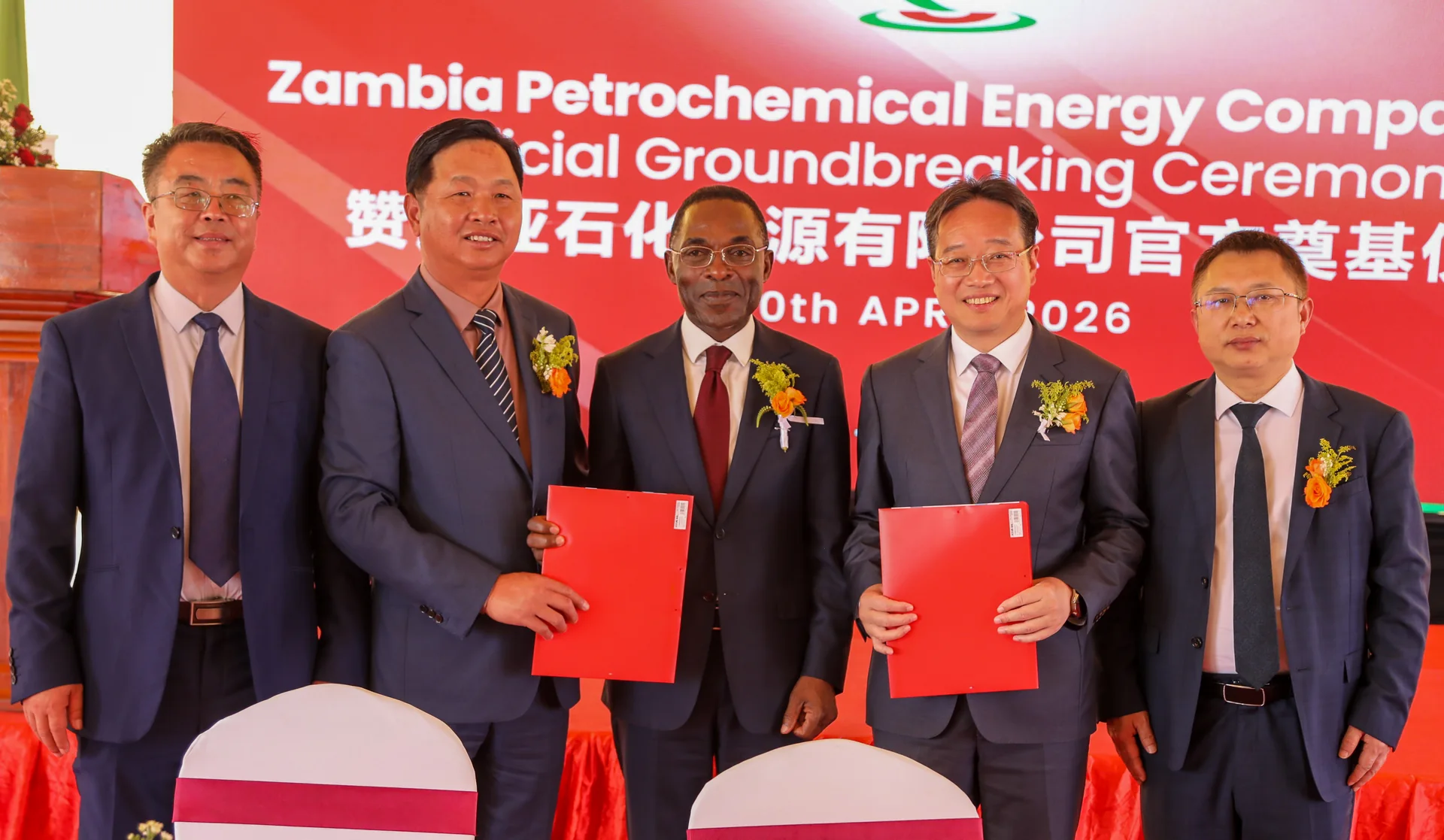
The scale of what is being built is considerable. Once complete, the refinery will process three million tonnes of crude oil annually – about 60,000 barrels a day – enough to cover Zambia’s current fuel needs while leaving room for exports to regional markets. Construction is being phased, with the first stage due within 18 months of breaking ground. The project is expected to generate more than 2,200 jobs at peak construction, followed by over 600 direct and 2,000 indirect positions once operational: more than 3,000 livelihoods tied to a single industrial site. Beyond fuel, the integrated complex will include LPG bottling, bitumen production and lubricant blending, with knock-on demand for storage infrastructure, rail development and materials for plastics, fertilisers and asphalt – openings that officials say smaller Zambian firms in logistics, maintenance and catering stand to benefit from as well.
For Wang Shen, the project carries historical resonance. He invoked the TAZARA railway, built more than five decades ago by Chinese and Zambian workers who took five years and eight months to lay 1,860.5 kilometres of track. “The TAZARA spirit – featuring equality, perseverance and selfless internationalism – was forged in that era and remains a defining feature of China-Zambia cooperation to this day,” he said, framing the refinery as the latest expression of that relationship, backed by “affordable Chinese capital and world-leading Chinese technology.”
ZPEC and FJXX chairman Huang Tieming struck a similarly optimistic note, describing Zambia as standing “at a golden stage of political stability and rapid economic growth” under President Hichilema’s reforms. He argued the refinery would do more than end Zambia’s reliance on imported fuel: by laying groundwork for petrochemical products such as polyethylene and polypropylene, it could seed downstream industries in chemicals, textiles and coatings.
Financing is already taking shape. Access Bank has been appointed mandated lead arranger for a capital raise of up to US$365 million to fund the first phase, with an indicative commitment of up to US$100 million at financial close.
IDC CEO Mr Cornwell Muleya says the refinery is proof of concept for Zambia’s wider investment climate. “We see this project as a signal to other private sector entities and investors, both inside and outside Zambia, that you can come to this country and develop a project that is properly designed,” he said, adding that IDC remained focused on projects that serve “the ordinary people of Zambia,” not just financial returns.
Whether the refinery delivers on that promise will depend on execution over the next 18 months and beyond – financial close, equipment procurement, and the logistics of moving specialised refinery components into a landlocked country. But for a project that moved from a chance business forum to a groundbreaking ceremony in under a year and a half, momentum is, for now, on its side.